

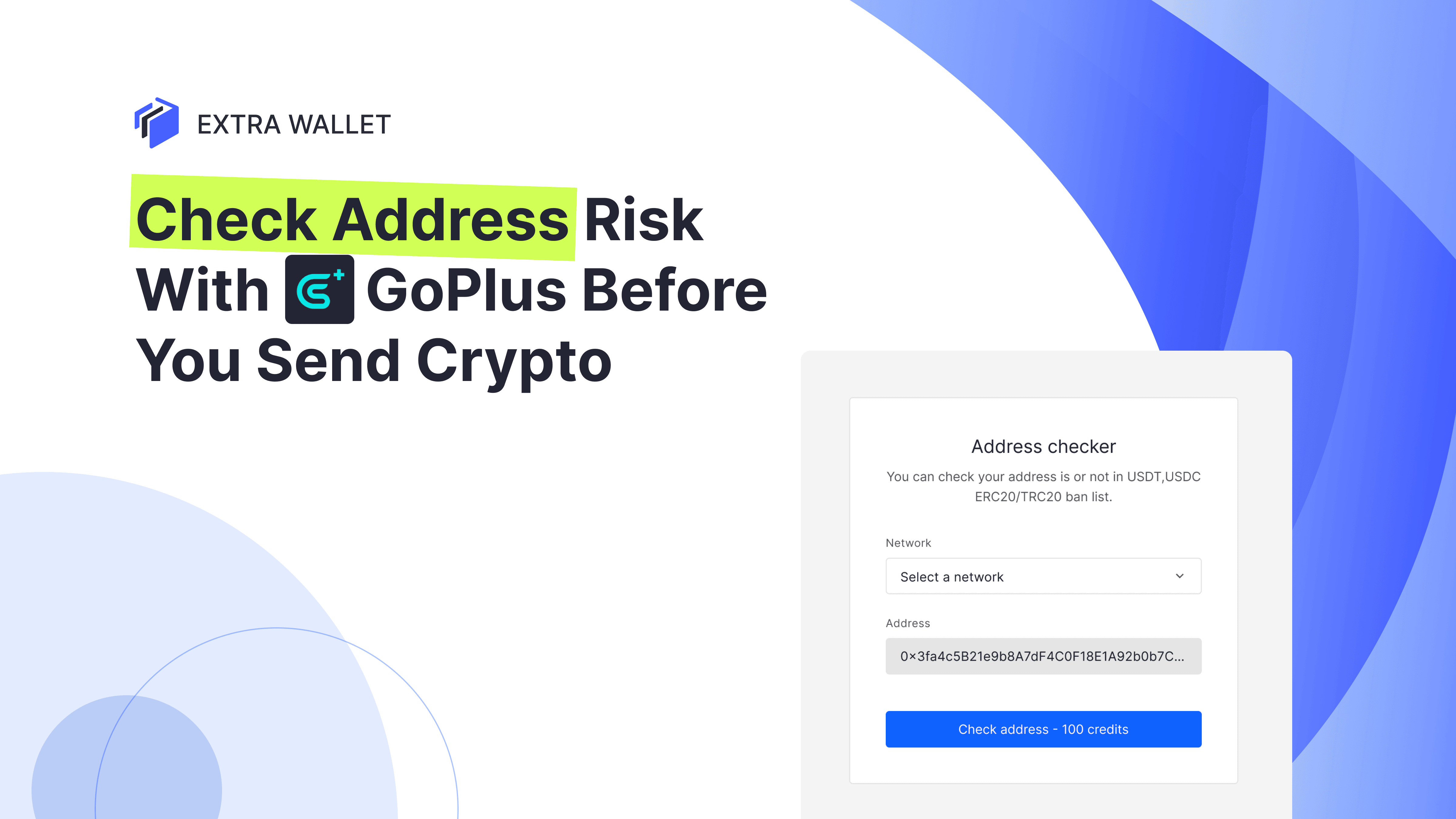
This series invites you behind the scenes of EXTRA WALLET, unveiling the architecture and smart technologies that simplify and secure your daily crypto activities.
In this text, we’ll talk about GoPlus, the security infrastructure layer behind the Address Checker extension in EXTRA WALLET.
Blockchain transactions are irreversible. Once confirmed on-chain, there's no undo button. If you send funds to the wrong address or a malicious contract, there is no customer support to recover your assets.
This creates ongoing risks for users. Scam tokens often copy trusted assets like USDT, using the same symbol and appearance to trick people into buying worthless tokens. Malicious contracts and hidden drain functions can stay inactive for months or years. For example, one user lost about 908,000 USDC after signing an approval 458 days earlier, which was later used to drain their wallet without any further action.
Phishing sites and fake airdrops often look like real DeFi platforms. They prompt users to connect wallets or sign approvals, which attackers then use to withdraw funds. Dusting attacks send small token amounts to link wallet addresses and track activity, reducing privacy. Address poisoning and copy-paste attacks add look-alike addresses to your transaction history. In one case, this caused a loss of nearly 50 million USDT when a user copied a fraudulent address from their own history.
These risks do not come from breaking cryptography. Instead, they take advantage of trust, limited visibility, and the absence of address risk intelligence at the moment decisions are made.
Address verification helps reduce these risks. It does not eliminate risk entirely, but it gives users concrete signals to base decisions on rather than assumptions. In EXTRA WALLET, this is done through the Address Checker extension, which uses GoPlus Security integration.
What is GoPlus?
GoPlus is a Web3 security data platform. It collects risk signals from tokens, smart contracts, and wallet addresses, and provides risk assessments through an API.
GoPlus monitors over 30 blockchains and provides threat intelligence to more than 12 million wallets. It does not execute transactions, hold funds, or access private keys. It works as a read-only analysis layer.
GoPlus collects data from multiple sources:
On-chain event monitoring
Contract code analysis
Historical exploit databases
Community-reported phishing lists
Issuer-published blacklists
It analyzes blockchain data to classify wallet addresses and smart contracts by risk level. It detects patterns linked to scams, theft, sanctions exposure, mixer use, and known vulnerabilities.
When you check an address in the Address Checker extension, EXTRA WALLET sends a query to GoPlus and receives a structured risk assessment. The results show clear severity indicators and detailed explanations.
This gives you context for your decision. A 'low risk' result means no known red flags were found during the check. It does not mean the address is verified or completely safe.
How It Works in EXTRA WALLET
Address Checker is an extension available in the Apps section of EXTRA WALLET. It does not automatically check addresses during transactions. You activate it manually whenever you want to verify an address.
Address Checker supports multiple blockchain networks and shows a clear overall risk level: Low, Medium, or High, with detailed explanations for each category. It also displays context, such as the contract creation time. The tool works instantly and does not require wallet connection, permissions, or transaction signing.
The workflow follows this structure:
1.
Open Address Checker.
2.
Choose a chain (e.g., Ethereum, Optimism, BSC).
3.
Paste the address (must match the selected chain).
4.
Click Check (or press Enter).
5.
Review the results: overall risk (Low/Medium/High), contract first transaction (if applicable), and expandable security details.
6.
Click Reset to check another address.
You review the risk signals and decide whether to continue, investigate further, or stop the interaction.
Key Boundaries
Address Checker operates with clear limitations:
1.
Address Checker does not automatically block transactions. You can choose to ignore risk signals and continue with any transaction. The module provides information but does not enforce actions.
2.
It does not guarantee safety. A 'low risk' result only means no tracked red flags were found at the time of the check. New threats can appear at any time, and intelligence sources may update with delays.
3.
Address Checker analyzes one blockchain at a time. The same address can exist on different networks, and risk signals may vary by chain. An address flagged on Ethereum might not be flagged on Polygon.
4.
Address Checker uses only public data. GoPlus analyzes on-chain activity and aggregated intelligence, but does not access your private transaction history, local wallet state, or encrypted messages.
How Address Checker Handles Your Data
Address Checker analyzes only public blockchain data. When you paste an address, the extension sends it to GoPlus Security’s API to get risk intelligence. Since blockchain addresses are public, this does not expose any new sensitive information. The tool is read-only and does not access your wallet contents or internal state.
Your private keys, mnemonic phrase, and signing credentials always stay on your device. Address Checker operates independently of EXTRA WALLET’s isolated signing environment and cannot sign, approve, or execute transactions. GoPlus does not hold funds or control assets. EXTRA WALLET does not store the addresses you check after your session ends. You keep full custody, signing authority, and control at all times.
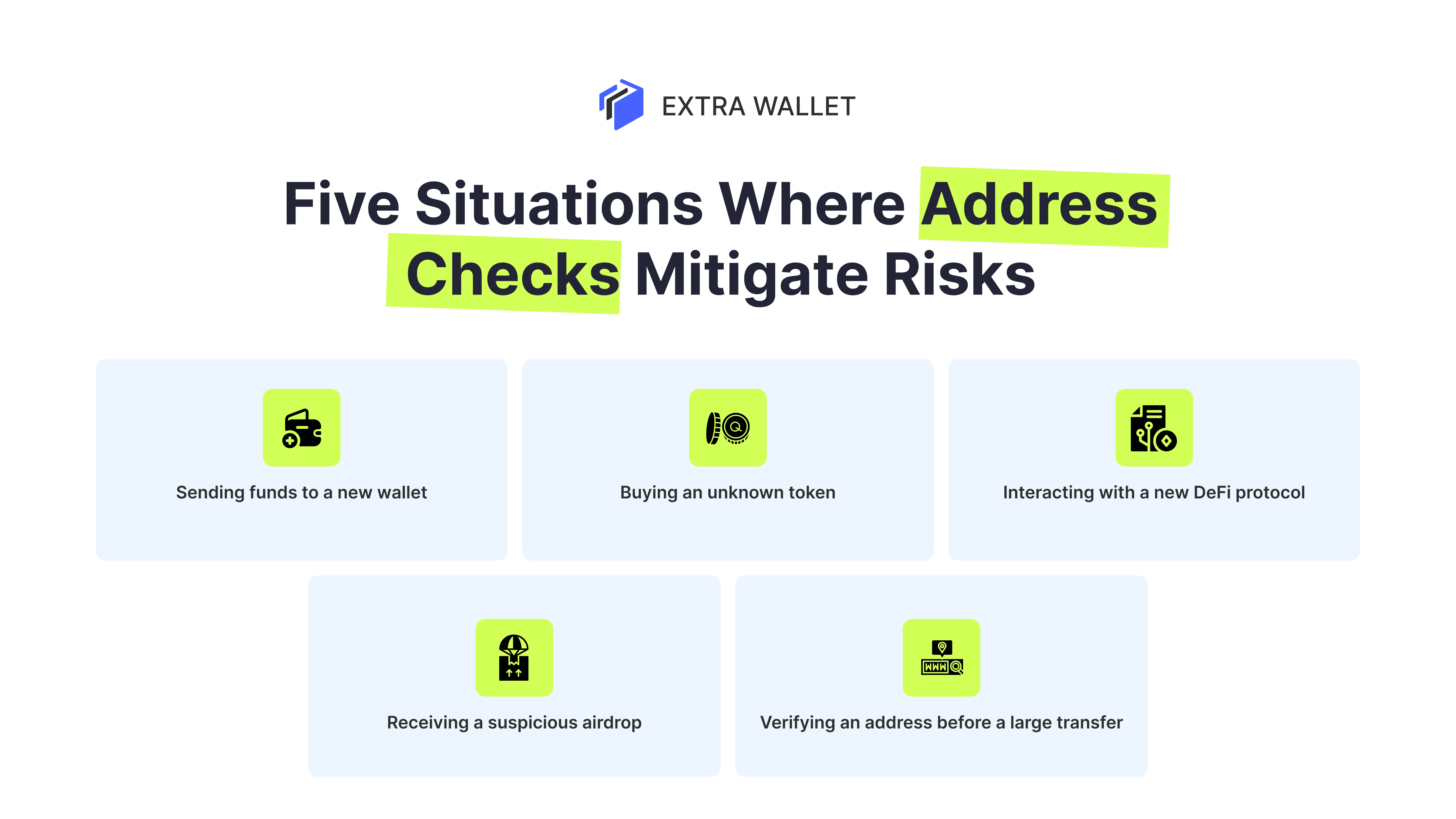
Use Cases for Crypto Address Lookup
Address Checker applies to several practical scenarios:
1.
Sending funds to a new wallet. Before transferring assets to an unfamiliar recipient, check the address for phishing, sanctions exposure, or prior abuse. If it's flagged for phishing or sanctions, reconsider the transaction.
2.
Buying an unknown token. You found a token contract on social media. Before purchasing, check the contract address. Risk flags may reveal honeypots, exploit history, or suspicious deployment patterns.
3.
Interacting with a new DeFi protocol. You're about to approve a contract interaction for a yield farm or liquidity pool. Verify the contract address first. Check for previous exploits, unusual permissions, or unverified code.
4.
Receiving a suspicious airdrop. Unexpected tokens appear in your wallet. Before interacting, check the token contract. Many dusting attacks and phishing schemes rely on users approving malicious token contracts.
5.
Verifying an address before a large transfer. A clean result doesn't guarantee correctness, but a flagged result prevents an irreversible mistake.
Key Takeaways
Address verification adds an important decision layer between your intent and the actual transaction. It turns unclear wallet addresses into clear, structured risk signals. This helps you spot phishing, malicious contracts, and copy-paste errors before assets move on-chain, reducing avoidable losses while keeping you in control.
In EXTRA WALLET, address verification is available as an extension you can activate with one click. It brings risk intelligence directly into the verification step, enabling you to make informed decisions and maintain full custody and control over every transaction.
Join the EXTRA WALLET Closed Beta
Be part of shaping the next standard in crypto.
Request to Join the BetaEXTRA WALLET is now in closed beta testing. The architecture is stable, and further improvements will be based on real-world use and feedback. Try the platform, test advanced workflows, and help improve the next standard for secure crypto platforms.