

This series invites you behind the scenes of EXTRA WALLET, unveiling the architecture and smart technologies that simplify and secure your daily crypto activities.
In this text, we’ll talk about Tenderly, the infrastructure layer that powers the Transaction Simulation extension in EXTRA WALLET.
Transaction simulation is becoming a basic standard for how crypto platforms operate, rather than just an additional feature. In recent years, several high-profile incidents have occurred, including attacks on Bybit, WazirX, and Radiant, in which users were tricked into signing malicious transactions through compromised or deceptive interfaces. These attacks caused losses from tens of millions to one and a half billion dollars, showing that blind signing is already a systemic risk.
The ability to see the actual on-chain effect of an action before the final confirmation is a critically important layer of protection for a crypto user.
In EXTRA WALLET, this approach is implemented via the EVM Transaction Simulation extension, which leverages Tenderly integration.
What is Tenderly?
Tenderly is a Web3 infrastructure platform that provides tools for transaction simulation, analysis, and monitoring across EVM-compatible networks. For wallets, its key function is the Transaction Simulation API. This lets a transaction be run in a virtual environment that replicates the current state of the blockchain, so users can see its actual on-chain effect before signing.
Thus, it is an infrastructure layer that helps solve important tasks for crypto users:
Enables users to preview the transaction's outcome before sending it to the network.
Shows asset changes (which tokens will be received/sent), balance changes in USD equivalent, gas estimation, state changes, and emitted events.
Warns if a transaction will fail (revert).
Detects potential security red flags – suspicious contracts, malicious approvals – before signing.
The platform now handles tens of millions of simulations and billions of RPC calls. Wallet providers, DeFi protocols, and L1/L2 networks integrate Tenderly as an infrastructure partner. Tenderly is, in a way, an industry standard in transaction simulation.
How It Works in EXTRA WALLET
In EXTRA WALLET, transaction simulation is implemented as the EVM Transaction Simulation extension, which runs on integration with Tenderly. You can find it in the Apps section.
EXTRA WALLET is built on a modular architecture, so you see only the core capabilities at first. Additional tools, such as transaction simulation, are enabled separately as needed. To activate the feature, go to Apps and switch the toggle on. Once activated, you’ll be able to simulate a transaction in the transaction preview modal before signing.
From there, everything happens within your usual workflow. You initiate any action, such as sending, swapping, or staking, and the transaction signing modal opens. Before confirming, click Simulate. The system performs a dry-run of the transaction and shows the result:
Whether it will complete successfully (Success),
Whether it will revert (Failed),
Which tokens will be sent or received,
How the balance will change,
What fee will be spent.
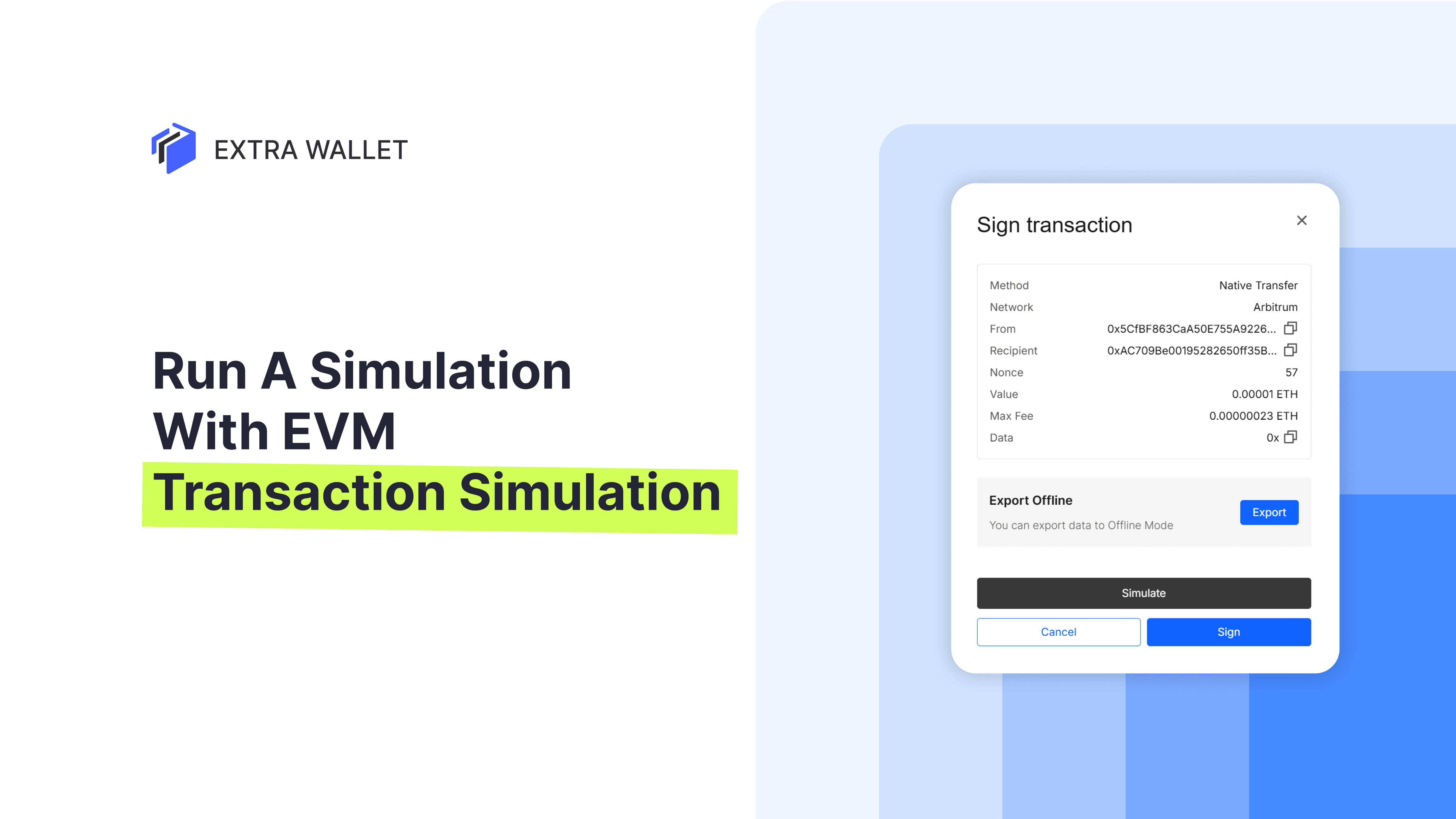
If needed, click Re-Simulate to update the result based on the network's current state. If everything looks correct, sign. If not, cancel and adjust the parameters.
Behind the scenes, the transaction is modeled in a virtual environment that replicates the network's current state. The integration with Tenderly lets you see the on-chain impact of the action before confirmation, without risking your assets.
Important tip: if you change the amount, calldata, gas parameters, slippage, or the recipient address, you should rerun the simulation.
The main advantage of EVM Transaction Simulation is that you are not signing transactions “blindly.” You see their consequences before they become irreversible.
How Simulation Handles Your Data
Transaction simulation in the EXTRA WALLET does not create additional privacy risks. When calling the Simulation API, only public transaction parameters (unsigned payload) are sent: from, to, value, input (data), gas parameters, and network_id. These are the same data points that are publicly visible in any block explorer after a transaction is sent.
What’s important:
Private keys, mnemonics, and passwords never leave the signing environment.
Tenderly works with unsigned transactions, meaning a signature is neither required nor transmitted.
During simulation, the transaction is not broadcast to the network and does not change the on-chain state.
The integration operates as a read-only simulation layer. Tenderly is not a custody solution. It does not have access to your assets and cannot initiate or sign transactions on your behalf.
Thus, you control your keys, and the simulation simply helps you make a more informed decision before signing.
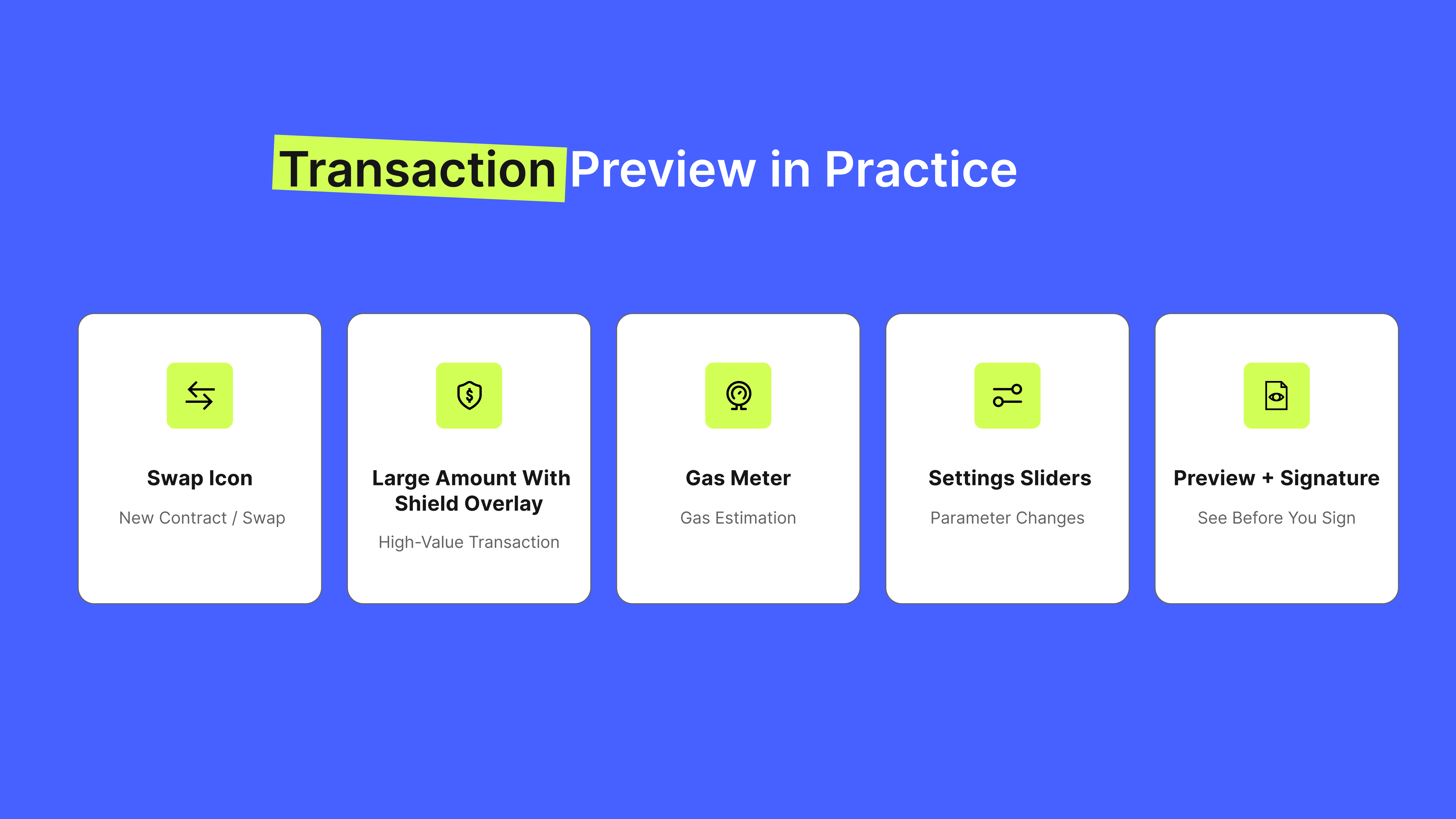
User Cases: When Simulation Really Matters
Let's look at practical cases where it's really important to run a simulation.
1. Swap or interaction with a new contract
You are interacting with a protocol for the first time or connecting to a new dApp. Simulation lets you see which tokens will be deducted, if an unexpected approval appears, and if the transaction will revert. This matters when you are not yet familiar with the contract.
2. Large amounts or complex multi-step actions
Staking, bridging, and complex DeFi operations involve multiple contract calls. Simulation shows the on-chain effects before signing, helping avoid costly mistakes.
3. Gas cost control
Before sending, you see the estimated gas consumption and avoid spending on transactions that could fail.
4. Checking modified parameters
Re-simulation provides confidence that new parameters, such as changes in amount, slippage, calldata, or recipient address, do not alter the execution logic.
5. Conscious signing instead of “blind signing”
You see exactly what will happen to your assets before the transaction becomes irreversible.
Key Takeaways
Transaction simulation is an infrastructure standard for modern EVM wallets. It adds needed predictability to crypto operations.
Instead of “sign and hope,” you preview and sign with understanding. This reduces the risk of human error, often the main cause of losses in this space.
In EXTRA WALLET, this capability is a separate module. You decide when to activate it and can do so in a second.
Join the EXTRA WALLET Closed Beta
Be part of shaping the next standard in crypto.
Request to Join the BetaEXTRA WALLET is now in closed beta testing. The architecture is stable, and further improvements will be based on real-world use and feedback. Try the platform, test advanced workflows, and help improve the next standard for secure crypto platforms.