

Crypto wallets have evolved, but using them is still complex. Many users manage several wallets, seed phrases, interfaces, separate signing flows, and recovery tools. Multi-chain support often means managing multiple wallets. All-in-one solutions can add more features, but often increase complexity rather than reduce it.
Switching between wallets and tools increases cognitive load and the risk of mistakes. Each extra step or blind signature can lead to errors or the loss of access. These usability and security issues are still major challenges for crypto users.
EXTRA WALLET takes a different approach. It unifies portfolio management across chains, separates key operations from the interface, and consolidates recovery tools, extensions, and external wallets into a single security-focused system. The goal is to reorganize control, not just add more features.
The launch focuses on reducing friction in key areas: fragmented management, scattered recovery processes, and an expanding transaction signing surface.
EXTRA WALLET is now in closed beta stage, and you can apply to join the beta testing. This is the first public step toward a more structured, security-first approach to managing crypto assets.
What Is EXTRA WALLET? One Platform for Multi-Chain Asset Control
EXTRA WALLET is a next-generation browser-based crypto platform built around portfolio management, signer isolation, and modular extensibility.
It is developed by the same team behind EXTRA SAFE Chat and follows the same core principle: full user control over data and assets. Together, the two products form a secure ecosystem for Web3 activity and protected communication.
At its core, EXTRA WALLET is:
An all-in-one crypto platform.
A multi-chain environment supporting major native chains and unlimited custom EVM networks.
A modular wallet with easy-to-activate extensions.
A split-architecture system where keys remain isolated from the interface.
Unlike traditional wallets built around a single account view, EXTRA WALLET uses a structured hierarchy: Portfolio → Wallet → Account.
This enables separation between different environments within a single unified platform.
Why Modern Crypto Users Need More Than a Traditional Wallet
Today’s crypto users operate across:
Multiple EVM chains
Native networks like Bitcoin and Solana
DeFi protocols
Hardware and software wallets
Cold and hot storage environments
Most wallets were not designed for this reality. They evolved incrementally, adding features to a single application surface. The result: larger attack surfaces, key exposure risks, fragmented portfolio management, and dependency on multiple apps.
EXTRA WALLET uses a different architecture.
What Makes EXTRA WALLET Different?
Let's take a look at the unique features EXTRA WALLET offers to crypto users and web3 developers.
1. Split Security Model: Sensitive Operations Kept Separate
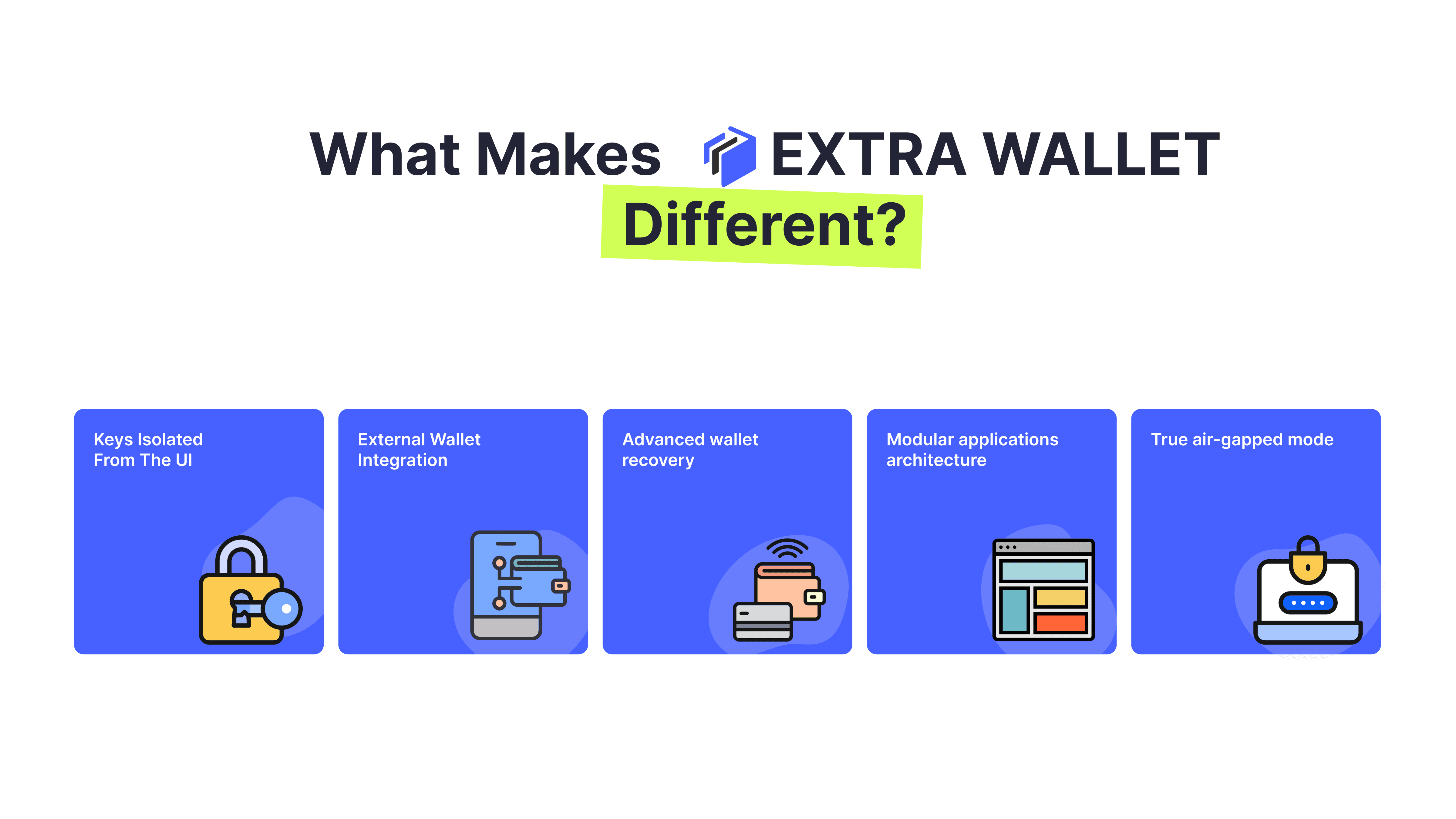
Most browser wallets handle UI rendering and key management in the same origin. EXTRA WALLET separates them.
The wallet interface runs on one origin. All sensitive operations, such as key storage, mnemonic access, and signing, occur within a dedicated Signer application running in a separate iframe on a different origin.
The wallet interface never handles your raw private keys. They remain encrypted and isolated in a separate environment designed specifically for sensitive operations.
So even if the interface were ever compromised, your keys couldn’t simply be pulled out. The most critical layer of control is intentionally kept out of reach.
2. External Wallet Integration: Manage Ledger, MetaMask & More in One Interface
EXTRA WALLET does not require you to abandon existing infrastructure. Hardware wallets such as Ledger and software wallets like MetaMask or Trust Wallet can be connected and managed from the same interface without signing in and out or switching between apps.
This lets you manage all your wallets in one place without needing to migrate assets, which is important for active users.
3. Advanced Wallet Recovery Across Multiple Blockchains
EXTRA WALLET supports 21 blockchain networks, including major native networks like Bitcoin, Solana, TON, XRP, Cardano, and Polkadot, as well as EVM-compatible chains such as Ethereum, Polygon, and Arbitrum, and unlimited custom EVM chains.
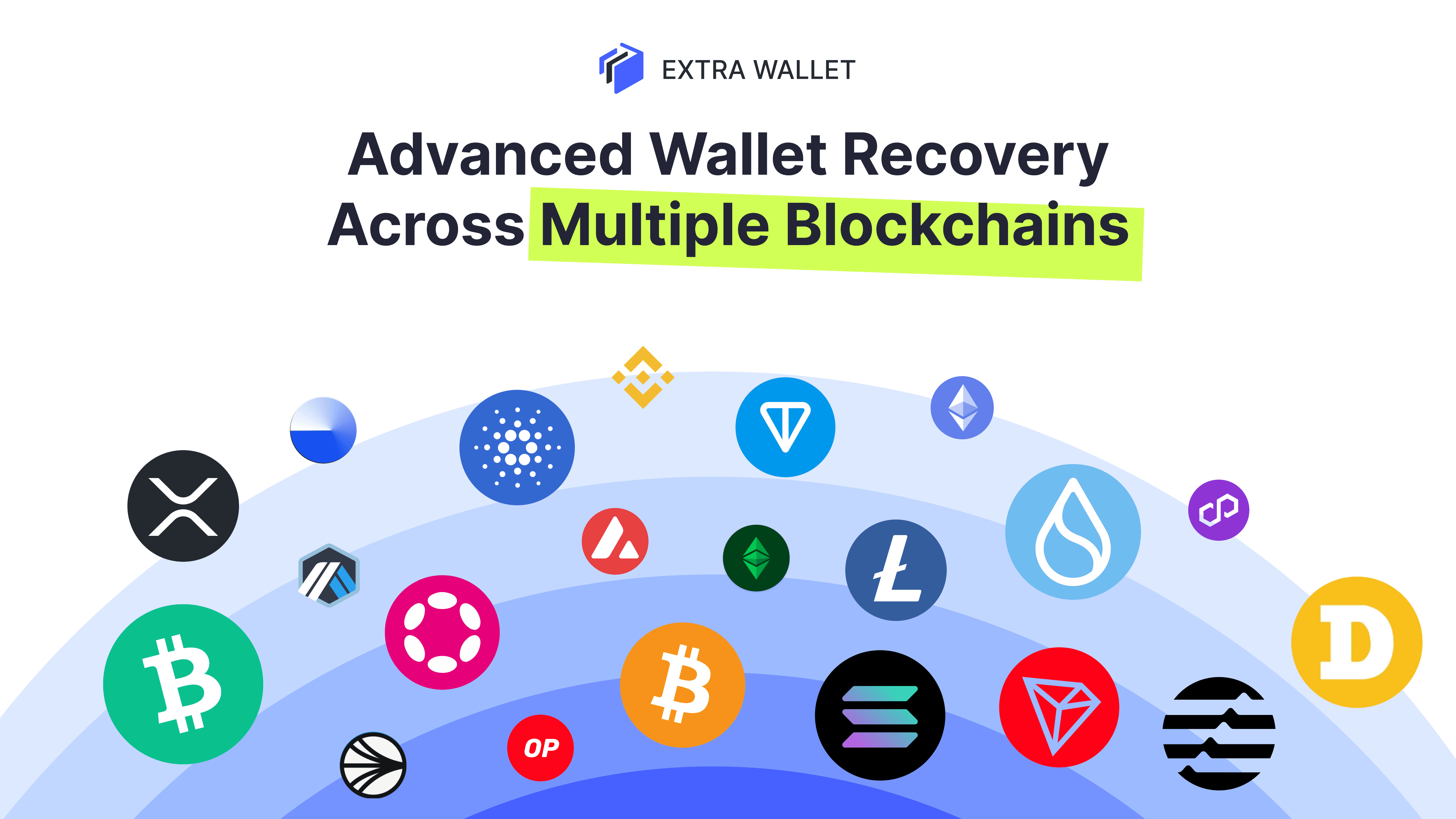
The Balance Recovery Tool scans derived addresses across chains to detect overlooked balances. Combined with flexible HD derivation presets and the Wallet Expander, recovery workflows can be executed both online and offline.
4. Modular Growth Without Added Complexity
EXTRA WALLET uses a modular architecture rather than bundling all features into a single application. The core wallet handles portfolio management and security. Other features, such as swaps, staking, address risk checks, transaction simulation, and recovery tools, are available as optional extensions.
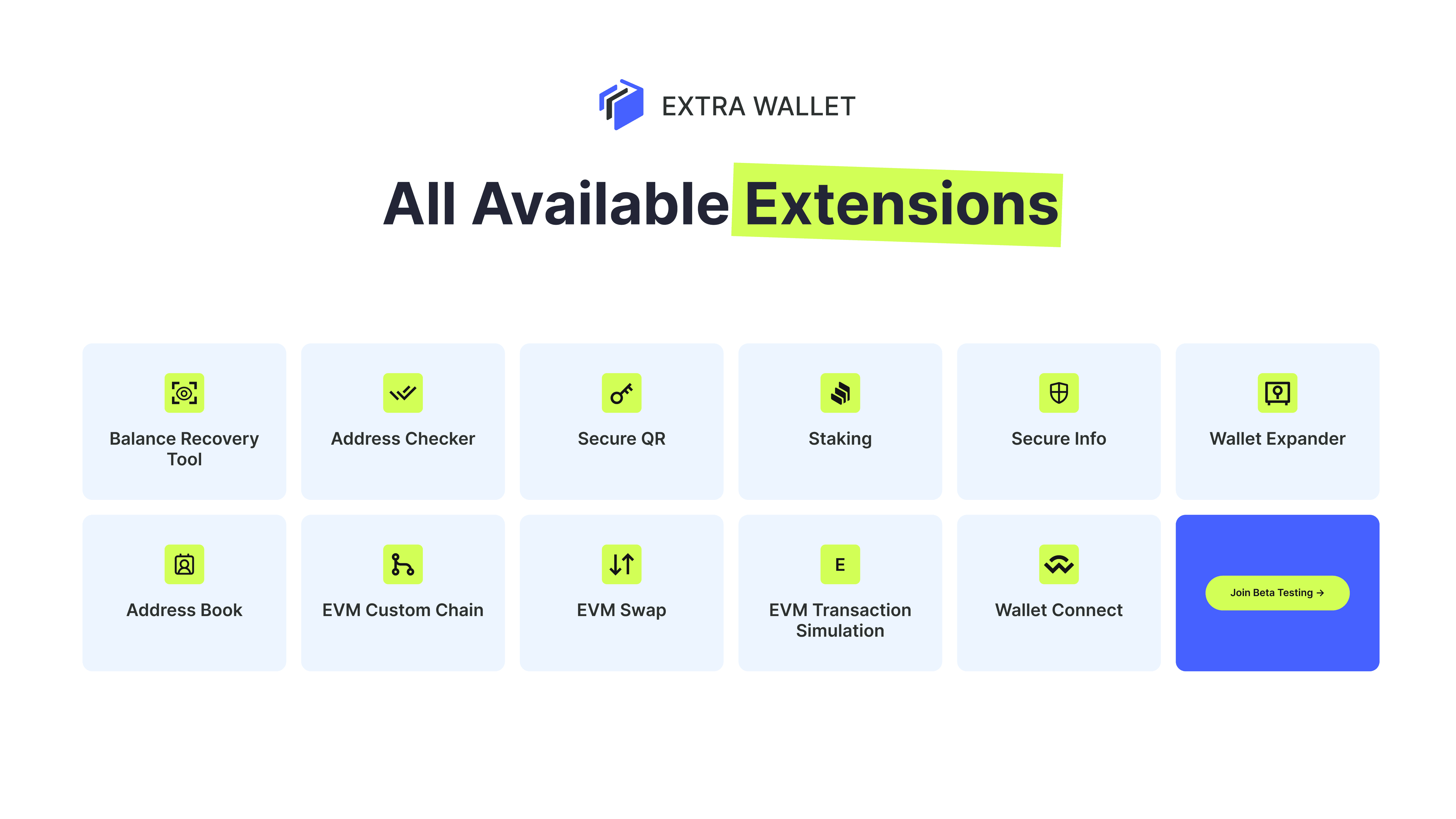
Activate extensions in one click when you need them
Extensions are off by default and can be enabled from the Apps section. They never have direct access to your private keys. This opt-in approach keeps the wallet simple, limits unnecessary code, and reduces risk.
5. True Offline Mode: Air-Gapped Wallet Creation and Transaction Signing
EXTRA WALLET’s offline wallet is designed for secure, high-sensitivity operations in a fully disconnected environment. It runs locally after download, does not fetch remote code, and isolates passwords, decrypted data, and signing flows inside a separate signer environment.
You can:
Create or import wallets offline.
Derive and manage accounts across networks.
Encrypt and decrypt sensitive data using password-protected QR codes.
Sign transactions in an air-gapped flow and broadcast them later.
How EXTRA WALLET Works: A Layered Architecture for Asset Control
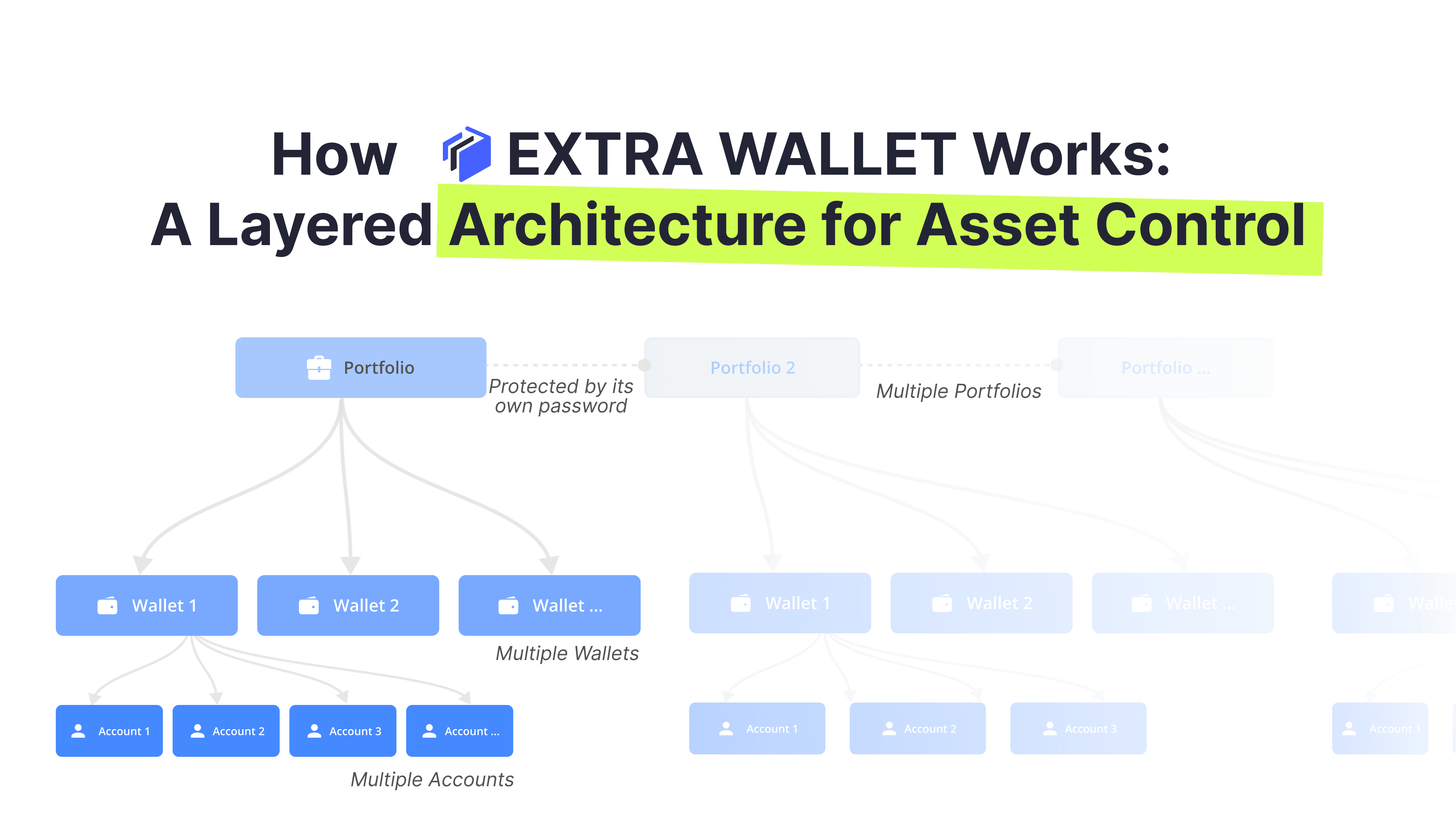
The wallet is organized into a three-level hierarchy to help you manage diverse assets across multiple networks
EXTRA WALLET is built around a structured hierarchy. You create a password-protected Portfolio, which can contain multiple Wallets, each capable of deriving Accounts across supported blockchains. This allows you to segment different contexts – personal use, business, and long-term storage – without juggling separate tools.
When you initiate a transaction, the interface handles the interaction layer, while sensitive operations are processed in a separate signing environment. The two layers communicate in a controlled way, keeping private keys outside the visible interface.
This creates a clear separation between usability and key control. The model reduces exposure without complicating daily workflows.
How Different Users Benefit from Using EXTRA WALLET
Customize EXTRA WALLET to match your needs: start with the basics if you're new to crypto, then add advanced extensions and integrations as you grow into a power user or Web3 developer.
1. Structured Multi-Chain Control for Active Crypto Users
If you use both EVM and native networks, EXTRA WALLET helps reduce fragmentation. You can manage multiple chains within a single structured portfolio, without switching wallets or reconfiguring networks or accounts. This gives you better asset visibility and fewer workflow gaps.
2. Reduced Exposure Through Isolated Workflows for Security-Conscious Users
If you want more control, EXTRA WALLET provides isolation where it is needed. Offline workflows, portfolio segmentation, and separate signing environments help reduce exposure while keeping the wallet easy to use.
3. Modular Infrastructure for Web3 Developers
For developers, EXTRA WALLET offers a flexible foundation. You can build modular extensions that integrate with the wallet, add new features as needed, and use a unified API for balances, gas data, transaction history, and network routing. HD derivation support across chains also makes it easier to implement advanced wallet logic and recovery workflows without having to build everything from scratch.
Join the EXTRA WALLET Closed Beta
Be part of shaping the next standard in crypto.
Request to Join the BetaEXTRA WALLET is now in closed beta testing. The architecture is stable, and further improvements will be based on real-world use and feedback. [Try the platform] (https://form.typeform.com/to/Kki5Ilgh), test advanced workflows, and help improve the next standard for secure crypto platforms.